Airplanes
July 4, 2024 - Reading time: 3 minutes
"How a pilot ended the globe"
They say you have to nose down planes, you don't, you use trim tabs to zero your Vertical Speed Indicator, which will simply account for any curve that exists. The stars rotate as predicted. He says the stars should rotate with the movement of the plane. This is due to parallax because the stars are far away.
Santiago to Sydney is 12 hours. How if flat?
Of course Eugene flew it. https://eugene.kaspersky.com/2015/09/09/the-santiago-sydney-antarctic-smile-qf28/
Great circle route shows that neither flight from Santiago: Johannesburg or Sydney, would go over Antarctica optimally on a globe. Straight shot over the water both ways.
https://www.greatcirclemap.com/?routes=SCL-JNB%2C%20SCL-SYD
Here's data from Sydney to Johannesburg visualized:
Planes nosing down
https://en.m.wikipedia.org/wiki/Phugoid 0.002 degrees of downward correction per second. For a jet this is around 100ft of elevation per minute. For a small plane it's every 5 minutes. Pilot use trim to correct. Combined with wind, air pressure, turbulence, the curve doesn't matter, similar to Coriolis for bullets. Find me a pilot that never uses trim. The aircraft manufacturer can even build this into the stabilizers in the back such that they balance the center of gravity and center of pressure with the curve of the earth at cruising speed. This would mean the pilot wouldn't have much to adjust beyond wind and pressure.
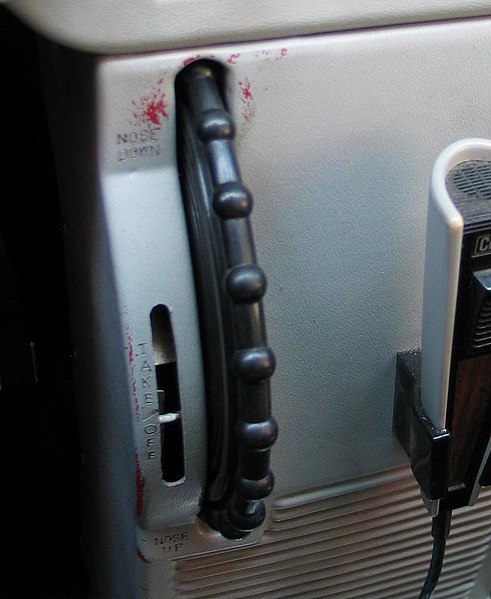
The trim control I've used, funny enough labeled "Nose Down"
Jet Pilot Convo
Uses Great circle route when flying to Korea from Texas Almost straight coming back No rudder used east to west versus north to south, only for wind correction of heading He says no pilots he knows are flat earthers Says he saw curve at 60k feet in F18
Bottom of airplanes lit
On a flat earth, the bottom of an airplane would never be lit by the sun because the sun would always be above it. Same goes for clouds lit by the sun at sunset and sunrise
Experiment Idea
Rocket launch just after sunset If globe, sun rises again If flat stays dusk