Earthrise Photos
August 12, 2024 - Reading time: 3 minutes
2015 Earthrise
This one is very interesting and I have to thank a friend (you know who you are) for bringing it to my attention! So there's a video here showing some photoshop levels tools being used on some images. I had no idea what images these were, so I tracked them down. I found quite a few examples of this image that didn't have the artifacts shown in the video, so I started to suspect the guy who made it. But then I found this post which pointed to a copy on Wikimedia Commons.

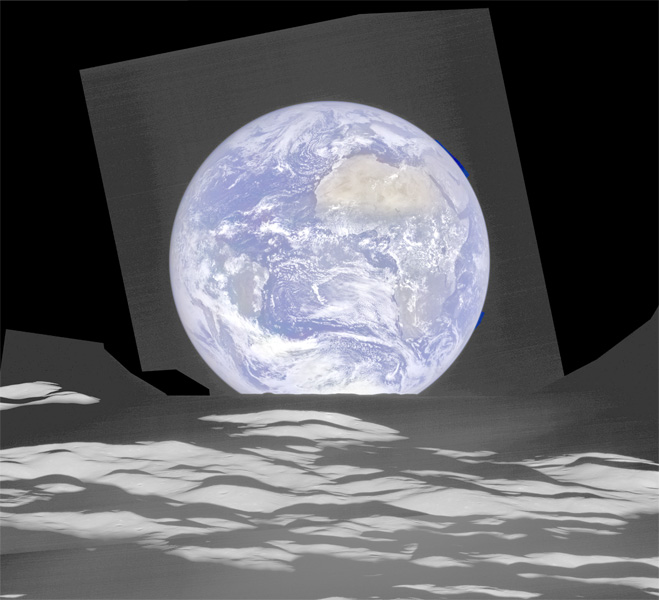
It appears it is a composite image! But why?! Perhaps there's trickery afoot!
I finally tracked this down showing what they were saying in 2015 about this photo. It matches exactly what the pages say now.
This image was composed from a series of images taken Oct. 12, when LRO was about 83 miles (134 kilometers) above the moon's farside crater Compton. Capturing an image of the Earth and moon with LRO's Lunar Reconnaissance Orbiter Camera (LROC) instrument is a complicated task. First the spacecraft must be rolled to the side (in this case 67 degrees), then the spacecraft slews with the direction of travel to maximize the width of the lunar horizon in LROC's Narrow Angle Camera image. All this takes place while LRO is traveling faster than 3,580 miles per hour (over 1,600 meters per second) relative to the lunar surface below the spacecraft!
The high-resolution Narrow Angle Camera (NAC) on LRO takes black-and-white images, while the lower resolution Wide Angle Camera (WAC) takes color images, so you might wonder how we got a high-resolution picture of the Earth in color. Since the spacecraft, Earth, and moon are all in motion, we had to do some special processing to create an image that represents the view of the Earth and moon at one particular time. The final Earth image contains both WAC and NAC information. WAC provides the color, and the NAC provides high-resolution detail.
It has always been called a composite image. Nothing was ever hidden about it. They overlayed the color from another sensor on top of the monochrome.